The sample about kafka, which use these libraries:
-
kafka-plus to support kafkajs, combine with mq-one for nodejs. Example is at kafka-sample.
We also provide these libraries to support GO:
- segmentio/kafka-go, IBM/sarama and confluent
- kafka to wrap go-stomp
- Simplify the way to initialize the consumer, publisher by configurations
- Props: when you want to change the parameter of consumer or publisher, you can change the config file, and restart Kubernetes POD, do not need to change source code and re-compile.
- Simplify the way to initialize the consumer, publisher by configurations
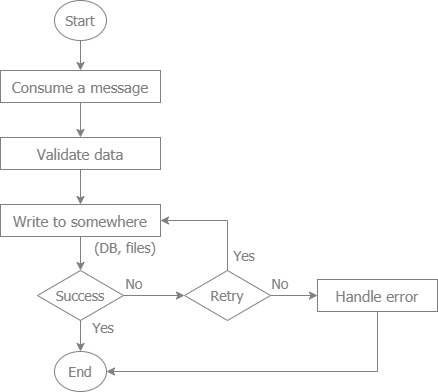
- core-go/mq to implement this flow, which can be considered a low code tool for message queue consumer:
A complete TypeScript sample application demonstrating how to build an event-driven service using kafka-plus (which wraps kafkajs) and the core-ts ecosystem.
The project shows how to produce and consume Kafka messages, validate payloads, process messages with retry support, persist data into MySQL, and expose health check endpoints.
Rather than being a simple Kafka example, this project demonstrates how multiple reusable infrastructure libraries can be composed into a clean, maintainable microservice.
- Kafka producer
- Kafka consumer
- Message validation
- Automatic retry processing
- MySQL persistence
- Structured logging
- Health check endpoint
- Environment-based configuration
- Lightweight HTTP server
- Clean dependency injection using a composition root
                 HTTP Request
                      │
                      ▼
               HTTP Application
                      │
                      ▼
               Application Context
                      │
      ┌───────────────┼────────────────┐
      │               │                │
      ▼               ▼                ▼
  Producer        Consumer         Health Check
      │               │
      │               ▼
      │       Message Processor
      │               │
      │          Validation
      │               │
      │         Retry Policy
      │               │
      │          Repository
      │               │
      └───────────► MySQL
All application components are created in a single composition root (context.ts), making dependencies explicit and easy to maintain.
- TypeScript
- Node.js
- Kafka
- MySQL
- kafka-plus
- message-processing
- logger-core
- validation-core
- mysql2-core
- config-plus
- health-service
src/
│
├── app.ts
├── context.ts
├── config.ts
├── model.ts
│
├── handler/
│   ├── validator.ts
│   ├── writer.ts
│   └── processor.ts
│
├── repository/
│   └── user-repository.ts
│
└── index.ts
HTTP Request

        │

        ▼

    Producer

        │

        ▼

   Kafka Topic

        │

        ▼

    Consumer

        │

        ▼

Message Processor

        │

        ▼

   Validation

        │

        ▼

      Retry

        │

        ▼

      MySQL
npm installUpdate the Kafka and MySQL configuration.
Kafka
-------
Broker
Topic
Client ID
Username
Password

MySQL
-------
Host
Port
Database
Username
Passwordnpm startor
npm run devPOST /send
Example
{
  "id": "u001",
  "name": "John Doe",
  "email": "john@example.com"
}
The application publishes the message to Kafka.
GET /health
Returns the health status of:
- Kafka
- MySQL
Example
{
  "status": "UP",
  "checks": [
    {
      "name": "kafka",
      "status": "UP"
    },
    {
      "name": "mysql",
      "status": "UP"
    }
  ]
}Incoming Kafka messages pass through several stages.
Kafka Message

      │

      ▼

 Validation

      │

      ▼

    Retry

      │

      ▼

  Repository

      │

      ▼

    MySQL
This separation keeps business logic small while making infrastructure concerns reusable.
The sample uses a simple composition root instead of a dependency injection framework.
createContext()

    │

    ├── Logger

    ├── Validator

    ├── Repository

    ├── Retry Policy

    ├── Processor

    ├── Producer

    ├── Consumer

    └── Health Check
This approach keeps dependencies explicit and easy to understand.
Most Kafka examples only demonstrate how to send and receive messages.
This sample demonstrates how to build a real service by combining reusable infrastructure libraries.
It shows how to:
- publish Kafka events
- consume Kafka events
- validate messages
- implement retry processing
- persist data
- expose health checks
- organize application dependencies
- keep business logic independent from infrastructure
| Library | Purpose |
|---|---|
| kafka-plus | Kafka producer and consumer abstraction |
| message-processing | Message processing pipeline with retry support |
| logger-core | Structured logging |
| validation-core | Data validation |
| mysql2-core | MySQL data access |
| config-plus | Configuration management |
| health-service | Health check aggregation |
MIT